
MCP vs API: what's actually different, explained with a real example
MCP vs API: MCP doesn't replace APIs; it sits on top of them, turning endpoints into tools AI can discover and use. The difference, with a real example.
On this page +
MCP versus API is the wrong fight, because they are not competitors. An API is how software talks to software: fixed endpoints, structured requests, predictable responses. MCP (Model Context Protocol) is a layer that sits on top of APIs and describes them to AI models, so an assistant like Claude or ChatGPT can discover what tools exist, what inputs they need, and when to use them, without a developer hard-coding every call. As Google Cloud’s developer team frames it, this is not a direct comparison at all: MCP sits one layer above APIs.
Here is the difference in practice, why it exists, and (because abstract explanations only go so far) what it looks like on a real system: the QuickBooks Online API.
MCP is moving quickly. The specifics below, such as tool counts and which vendors have shipped a server, are accurate as of August 2026.
The one-table version
| API | MCP | |
|---|---|---|
| Built for | Programs talking to programs | AI models talking to tools |
| The client is | Another application | The model itself |
| How the caller knows what to do | A developer reads the docs and writes code | The server describes its tools in a machine-readable way; the model discovers them |
| Integration effort | Custom code per integration | One MCP server; any compatible AI can use it |
| Behaviour | Deterministic: same call, same result | Probabilistic: the model reasons about which tool to call |
| Replaces the other? | No: APIs remain the foundation | No: MCP wraps and describes APIs |
Why APIs alone weren’t enough for AI
APIs assume both sides know exactly what to expect: you define an endpoint, send a request in the agreed shape, get the agreed response. For traditional software that contract is the whole point.
AI assistants broke the assumption. A model handling a real request might need several endpoints chained together, decide which ones based on the question, and interpret the results, and it does not inherently know your endpoint names, parameters, or auth dance. Google Cloud Tech’s explainer puts it well: a traditional API is like a locked cabinet where you need to know exactly which drawer to open and what shape the key is, while the model is trying to work out what is inside without labels. The workaround era meant hard-coding tool calls and stuffing prompts with instructions for every endpoint: brittle, bespoke, and repeated for every integration.
What an MCP server actually does
An MCP server is a small process that sits next to a system and describes it: here are my tools, here is what each one needs, here is what comes back, all in machine-readable schemas. The AI connects through one standardised interface, reads the descriptions, and calls tools directly. Nothing is guessed and nothing is hard-coded; it is self-describing.
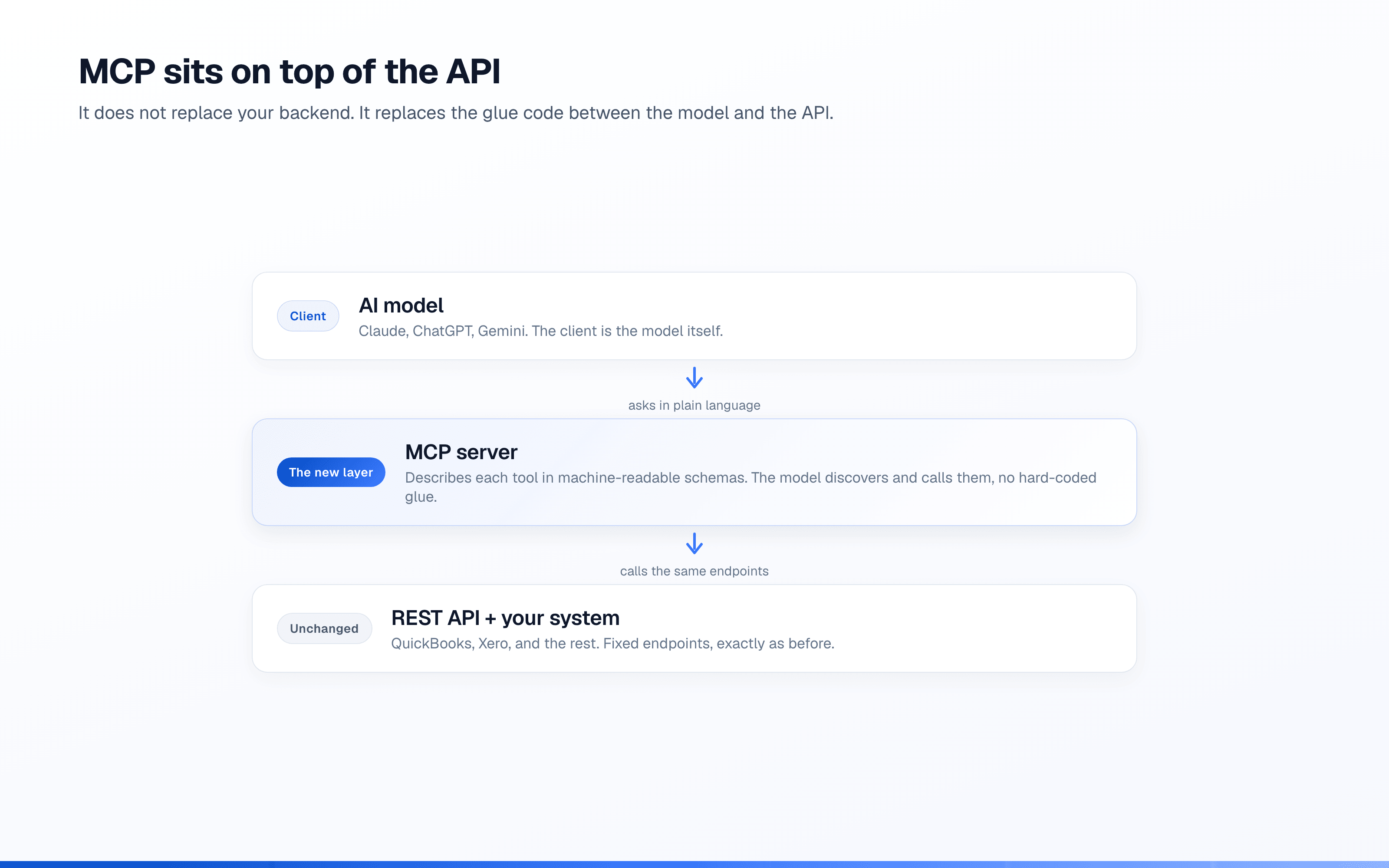
The cleanest one-line summary belongs to Google Cloud’s team: “MCP doesn’t replace your backend. It replaces the middleware between the model and the API.” Underneath, the QuickBooks MCP servers, Xero MCP servers, and everything like them are still calling the same REST APIs. MCP changed who can use them, a reasoning model instead of a developer’s code, and how much glue code that takes, which is roughly none.
The often-quoted analogy is HTTP: before it, every service had its own protocol; after it, everything interoperated. MCP is a bet on the same standardisation for AI tools. Build one MCP server, and Claude, ChatGPT, or Gemini can all use it.
If you are weighing which server to actually run against your own books, the Xero MCP guide and QuickBooks MCP guide compare every option side by side.
A real example: the QuickBooks API through MCP
Abstract enough? Here is what the difference means on a system we know well.
QuickBooks Online has a full REST API. Before MCP, “ask AI about your books” meant a developer writing a custom integration: an OAuth app, token management, endpoint wrappers, and prompt instructions teaching the model which call answers which question. With MCP, Intuit’s official QuickBooks MCP server exposes 140+ tools the model discovers by itself (invoices, payments, reports), and any MCP-capable assistant can use them.
But the example also shows what MCP inherits. The QuickBooks API’s query language allows no joins, no GROUP BY, and one entity per query. MCP describes those tools cleanly; it cannot make them more capable than they are. Ask something that spans several record types, say “which customers have overdue invoices, and what is each one’s total balance”, and the model has to stitch together multiple calls and do the arithmetic itself, which is exactly where wrong numbers creep in. An MCP server is a good translator; it is not a better database.
That is why hosted finance layers like Kipper pair MCP with a synced copy of the data: MCP handles the AI-to-tools conversation, and the synced relational copy answers questions that span many records as one query against complete records. MCP on top of the API, and a data layer underneath both.
What MCP does not fix
Three things carry over from the API world unchanged:
- Permissions. MCP is a protocol, not a policy. If a server exposes create and delete tools, a connected model can call them. Whether AI should ever write to your books is a deployment decision, which is why read-only-by-architecture options exist for finance data.
- The underlying API’s limits. As above: MCP describes tools; it does not upgrade them.
- Trust in the server. Someone still built the MCP server holding your credentials. Official and audited beats anonymous, same as it ever was.
All three are worth thinking through before you connect anything: what actually goes wrong when AI meets your accounting system.
FAQ
What is the difference between MCP and an API?
An API is how software communicates with software: fixed endpoints a developer codes against. MCP is an open protocol that describes APIs to AI models, so an assistant can discover and use tools dynamically instead of a developer hard-coding each call. MCP sits on top of APIs rather than replacing them.
Does MCP replace APIs?
No. APIs remain the foundation; MCP servers call them underneath. What MCP replaces is the custom glue code between an AI model and each API: one self-describing server instead of a bespoke integration per tool.
Is MCP just a wrapper around an API?
Structurally, often yes, but a standardised, self-describing one, and that is the point. Because every MCP server describes its tools the same way, any compatible AI client can use any MCP server without custom work. The wrapper is the interoperability.
Who created MCP?
Anthropic introduced the Model Context Protocol as an open standard in November 2024. It has since been adopted across the industry, including by AI assistants like Claude, ChatGPT, and Gemini, and by software vendors from Intuit to Oracle publishing MCP servers for their products.
Is MCP secure?
The protocol defines capabilities, scopes, and authentication, but safety mostly lives in the server and the deployment: which tools are exposed, whether they can write, who can connect, and what gets logged. For accounting data, prefer read-only, permissioned, audit-logged deployments.
When should I use a plain API instead of MCP?
When the client is software, not a model: scheduled jobs, system-to-system syncs, deterministic workflows. MCP earns its keep specifically when an AI model needs to decide which tools to use during a conversation.
See MCP working against real finance data: Kipper’s QuickBooks MCP connector, Xero MCP connector, or NetSuite MCP connector. By AI client instead: Claude, ChatGPT, and Gemini.