
QuickBooks MCP Servers Compared: All 6 Options (2026)
Intuit's official server, community builds, Zapier, CData, and hosted options compared on setup, write access, permissions, and cost. Updated 2026.
On this page +
Yes, there’s an official QuickBooks MCP server (Intuit publishes one on GitHub) and it’s the right starting point for developers. But it’s one of at least six serious ways to connect AI to QuickBooks Online, built for different users: developers who want raw API tools, automation builders who want AI taking actions, data teams standardizing access, and companies that want the whole team asking read-only questions safely. This comparison covers what each option actually does, what it costs, and the two questions that sort them faster than any feature list. New to the concept? Start with how MCP differs from an API. For the wider view of QuickBooks’ own AI and where it stops, see what Intuit gives you, and what it doesn’t.
Compared in this post:
- Intuit’s official QuickBooks Online MCP server
- Community servers: Wyre and LibreChat
- Zapier MCP for QuickBooks Online
- CData: two different offerings
- Kipper
Intuit’s official QuickBooks Online MCP server
intuit/quickbooks-online-mcp-server is the reference implementation, from the platform owner: 140+ tools across 29 entity types and 11 financial reports, the broadest documented QuickBooks Online surface on this list. It runs locally as a stdio process and authenticates via an app you create on the Intuit Developer Portal (OAuth 2.0; production setups need an ngrok tunnel or public callback for the first handshake).
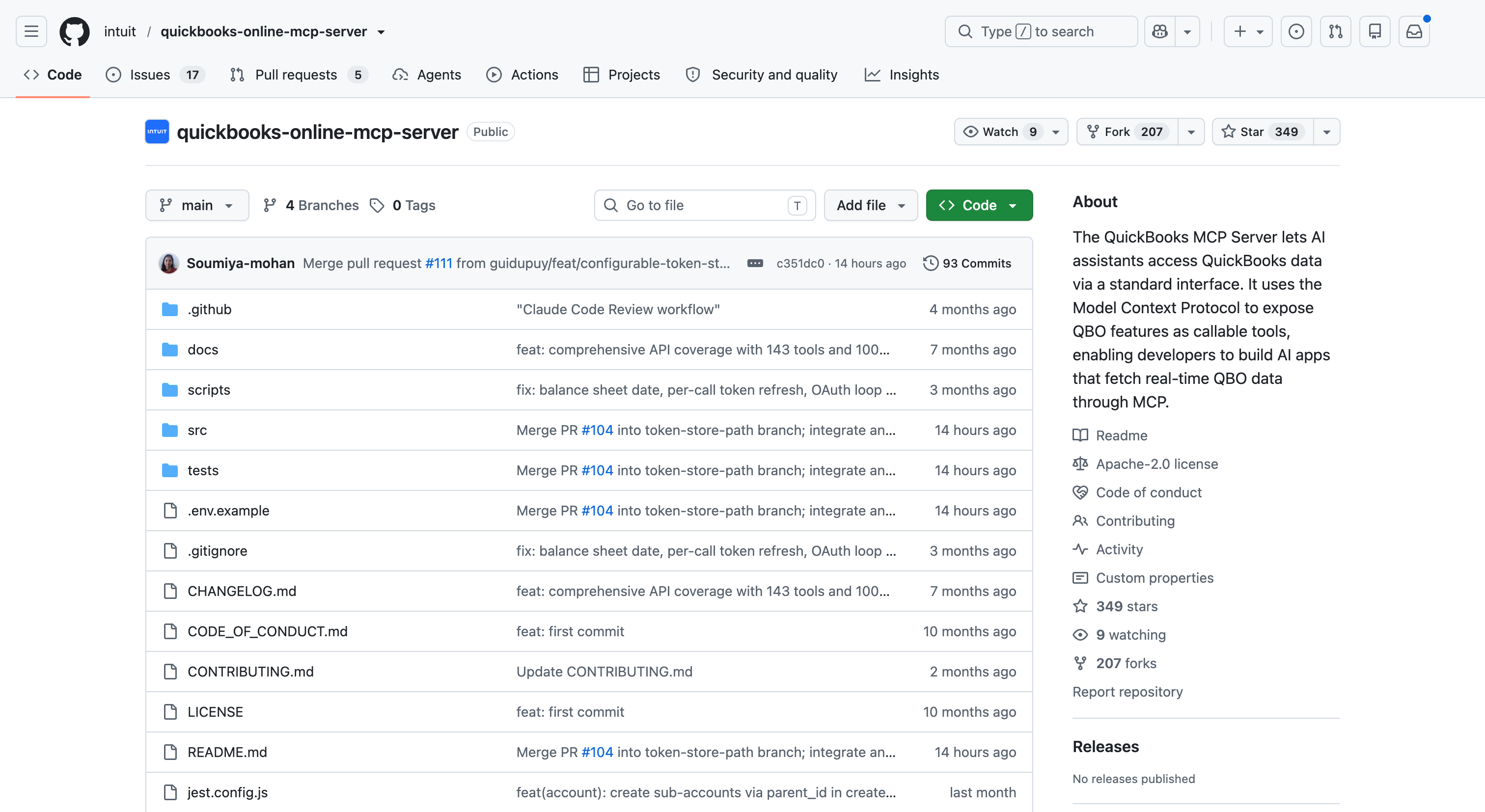 Intuit’s official QuickBooks Online MCP server is published on GitHub for developer-run local setups.
Two honest cautions. It’s a developer tool: someone builds it, owns the credentials, and keeps the process running. And it registers create, update, and delete tools by default; read-only operation means setting the QUICKBOOKS_DISABLE_WRITE, QUICKBOOKS_DISABLE_UPDATE, and QUICKBOOKS_DISABLE_DELETE flags yourself.
Choose it when: you’re a developer building something custom and want free, official, full-surface API access inside an MCP client.
Community servers: Wyre and LibreChat
The open-source ecosystem has produced credible alternatives with different deployment shapes:
wyre-technology/qbo-mcp: a community TypeScript server listing 130+ tools across 22 entities plus 10 reports, notable for gateway-style deployment patterns (header injection) alongside local stdio. Read-write for many entities; treat accordingly.
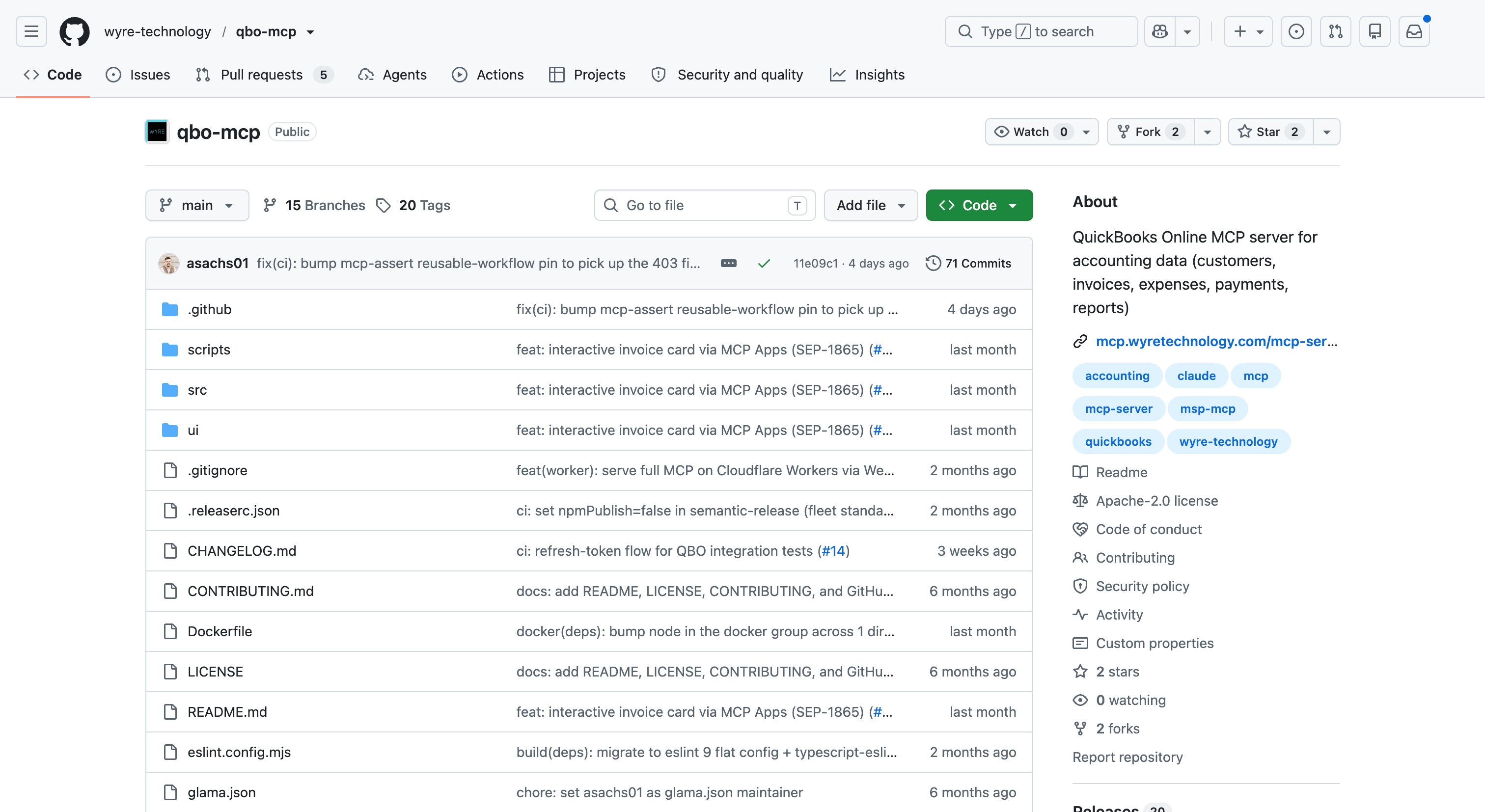 Wyre’s community QuickBooks MCP server is another developer-owned route, so review the code and tool surface before connecting production data.
LibreChat-AI/quickbooks-online-mcp: a QBO server rebuilt for Cloudflare Workers with OAuth 2.0 and SSE/Streamable HTTP transport, listing 55 tools. Interesting because it’s remote (an HTTP server rather than a local subprocess) which suits LibreChat-style stacks.
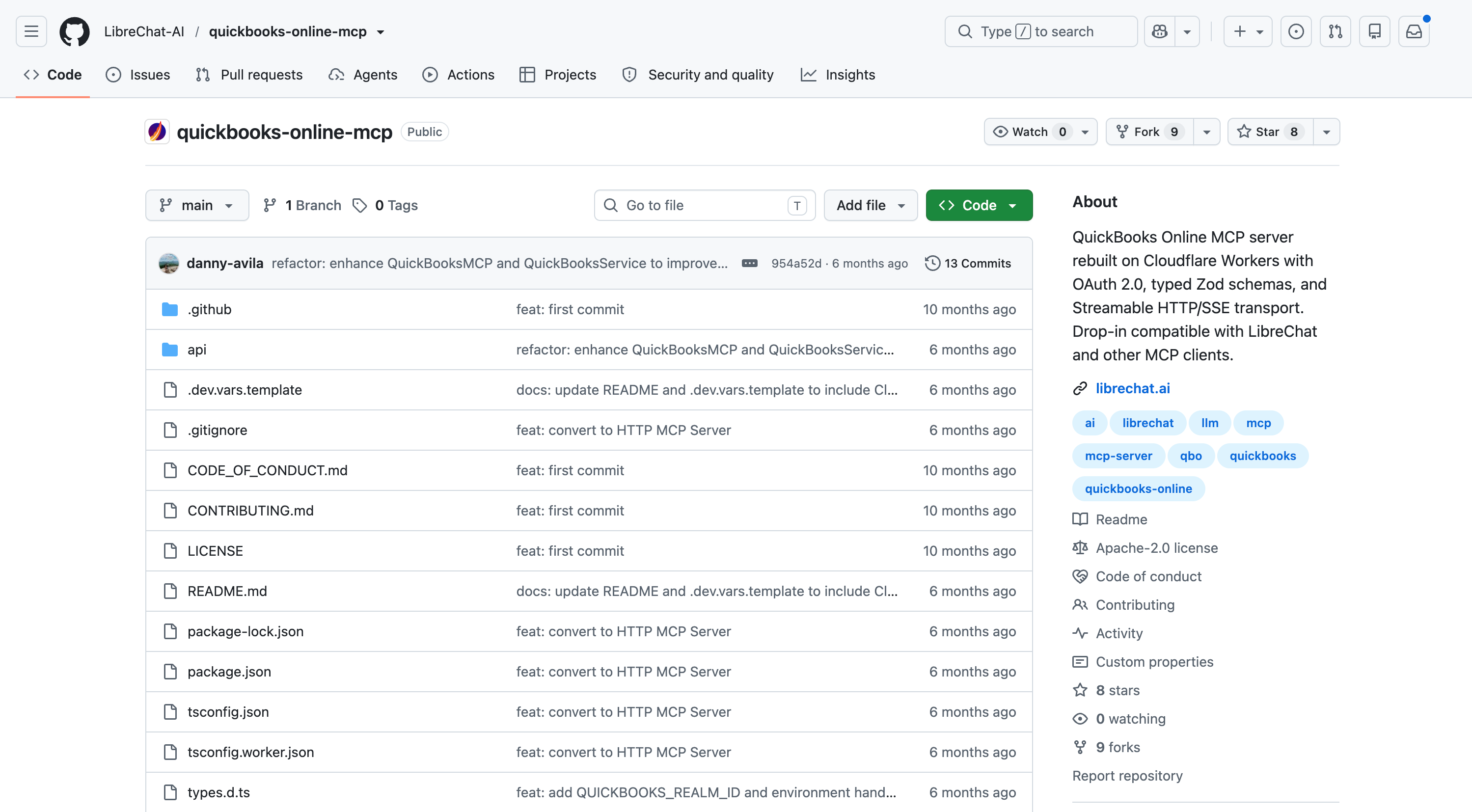 LibreChat’s QuickBooks MCP project is notable because it targets a remote Workers-style deployment rather than only local stdio.
Choose one when: the deployment shape fits (gateway or Workers) and you’re prepared to read the code first. With any community server holding accounting credentials, verify the license, the exact write surface, where tokens live, and how recently it’s maintained. Quality varies by author and month.
Zapier MCP for QuickBooks Online
Zapier’s QuickBooks MCP is action-first: create a bill, add a customer, attach a file, record a deposit, and the same endpoint reaches 30,000+ actions across 9,000+ apps, so one connection can drive QuickBooks alongside your CRM and project tools.
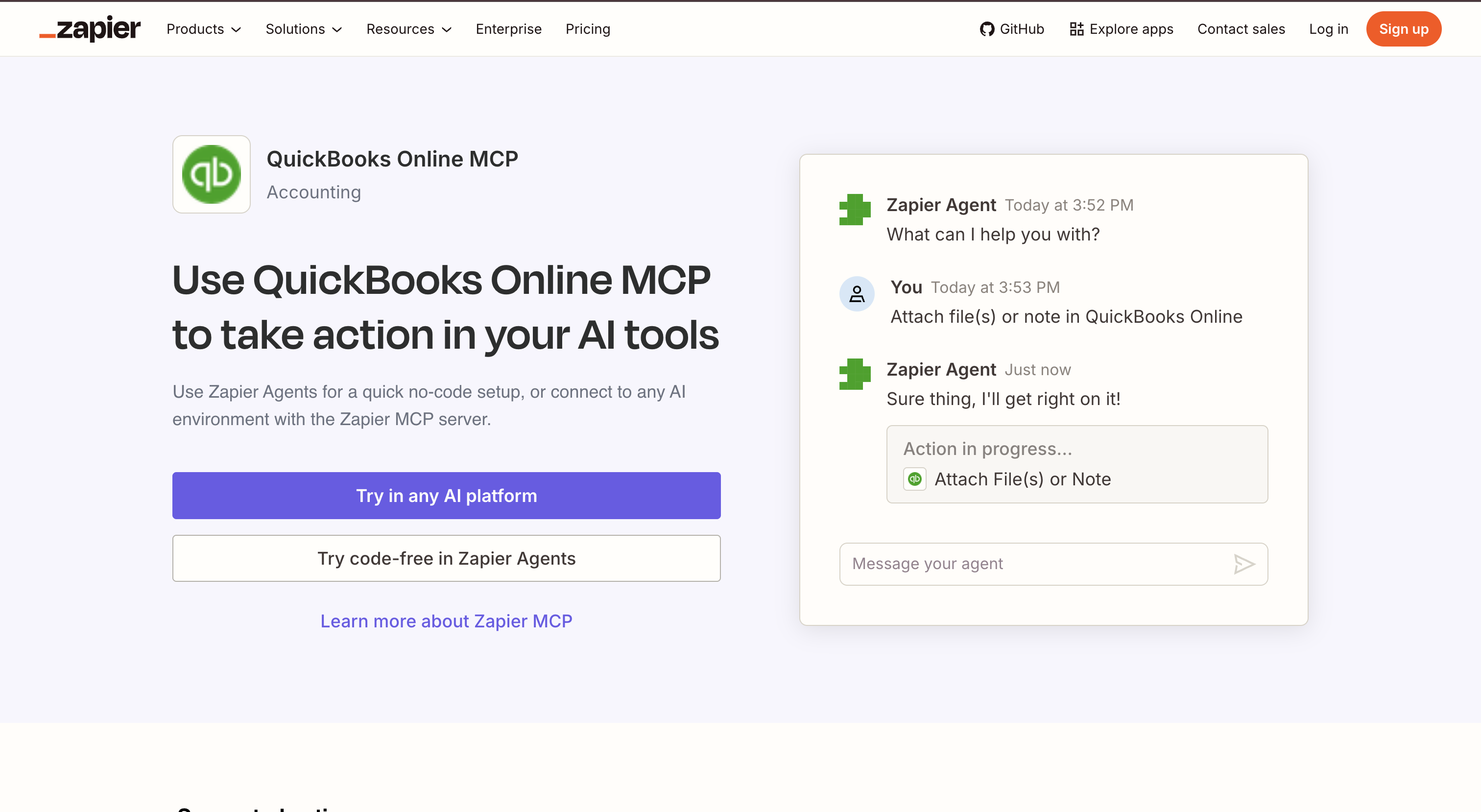 Zapier’s QuickBooks MCP route is strongest for automation workflows where an assistant is expected to take actions.
The trade-off is the mirror image of its strength: the tool list is dominated by create/update operations, which is the opposite of what you want for safe self-serve answers, and task-based pricing (one MCP call = two Zapier tasks) is hard to predict for a team asking questions all day.
Choose it when: you want AI doing things in QuickBooks inside broader automations, and the people holding the connection are trusted operators. Zapier, Composio, and Pipedream are compared side by side in QuickBooks MCP for AI Agents.
CData: two different offerings
CData appears twice in this market, and they’re often confused. The open-source CData QuickBooks MCP server is a read-only Java server exposing QuickBooks data as SQL-queryable tables through three tools (list tables, list columns, run SELECT), genuinely read-only by design, but it requires licensing CData’s JDBC driver underneath. Separately, CData Connect AI is their commercial cloud platform: a remote MCP endpoint for natural-language queries across QuickBooks and hundreds of other sources, aimed at IT and data teams standardizing AI access.
 CData’s QuickBooks MCP route is built around driver-backed, SQL-style access and its broader AI connectivity platform.
Choose CData when: you think in SQL and drivers (open-source route), or IT is rolling out AI access across many systems and QuickBooks is one source among several (Connect AI route). Both routes are broken down in CData QuickBooks MCP: SQL access compared.
Kipper
Kipper is built for a different user than everything above: the team that wants answers, not tools. It’s a hosted, read-only layer: writing to QuickBooks is architecturally impossible, permissions are set per user or team in an admin portal, and every question is logged. Today it answers natively in Slack, Microsoft Teams, and by text; the Kipper MCP beta extends the same governed access to QuickBooks answers inside Claude, inside ChatGPT, and inside Gemini. Signups are open now, with access rolling out. It also runs against a synced copy of your data rather than live API calls, which matters more than it sounds (see below). $200/month including 10 users and 2,000 questions, 14-day free trial (pricing as of August 2026).
Ask it yourself below. The demo shows Kipper fielding QuickBooks questions in Slack, ChatGPT, Claude, Gemini, and SMS on a sample data set, which is what governed answers look like instead of raw MCP tools.

Interactive · sample QuickBooks data
The honest trade-offs: it can’t take actions, and it’s a paid product. It’s also the only option on this list that reaches QuickBooks Desktop — via the Web Connector, in Slack, Teams, and SMS — alongside QuickBooks Online, Xero, and NetSuite. Desktop has its own separate set of options, none of them on this page; QuickBooks Desktop MCP covers Conductor.is, CData, and the roll-your-own routes.
Choose it when: the users are a finance team, ops, or the wider company, and read-only + permissions + audit trail are requirements rather than nice-to-haves.
The comparison at a glance
| Intuit (official) | Wyre / LibreChat | Zapier MCP | CData (OSS / Connect AI) | Kipper | |
|---|---|---|---|---|---|
| Built for | Developers | Developers, specific stacks | Automation builders | SQL users / data teams | Finance teams |
| Runs | Locally (stdio) | Local+gateway / Cloudflare Workers | Zapier cloud | Local Java / CData cloud | Kipper cloud |
| Write access | Yes by default (env flags to disable) | Yes for many entities / verify | Yes, action-oriented | No (OSS server) / query-focused | Impossible by architecture |
| Per-user permissions | No | No | Scoped actions per endpoint | Driver auth / platform auth | Yes, enforced per query |
| Audit trail | No | No | Task history | Platform logging | Every Q&A logged |
| Slack/Teams/SMS answers | No | No | No | No | Yes, same connection |
| Price | Free | Free (+ your time) | Plan-based, 2 tasks per call | Free OSS + JDBC license / subscription | $200/mo, 14-day trial |
All cells from vendors’ own READMEs and product pages, linked below; re-verify at publish (this category changes monthly); pricing as of August 2026.
The two questions that sort the market
Read or write? Intuit’s server (by default), Wyre, and Zapier let AI write to your books; CData’s open-source server and Kipper cannot. Decide which camp you’re in before comparing features: an AI that reads badly gives someone a wrong number; an AI that writes badly is a bookkeeping incident. If you want write workflows, restrict who holds the connection and test in a sandbox company first.
One user or the whole team? A local MCP server is one user, one machine, one OAuth connection. Remote deployments can serve more people, but then auth, per-user permissions, token storage, and audit logging are yours to build and operate. That gap (between “raw API tools for me” and “governed answers for everyone”) is the actual product boundary in this list, and it’s the one tool counts don’t capture.
The limitation nobody mentions: the QuickBooks API itself
One caution that applies to every tool-per-entity server above, including Intuit’s own. QuickBooks Online’s query language is deliberately narrow: no joins, no GROUP BY, one entity per query, paginated results. Standard report endpoints cover standard questions. The official server does expose aged receivables and payables, so “MCP can’t do AR aging” is false. But custom cross-entity questions (“compare this quarter’s expense categories to last, by vendor”) force the AI to stitch together multiple API calls and do the math itself, which is where wrong answers creep in.
That’s the design reason Kipper answers from a synced relational copy of your data instead of live API calls: comparisons and breakdowns become single queries against complete records, not multi-call reconstruction. It’s also a fair test to run on any option you evaluate: ask a cross-entity question and check the answer against QuickBooks.
FAQ
Is there an official QuickBooks MCP server?
Yes. Intuit publishes intuit/quickbooks-online-mcp-server on GitHub for QuickBooks Online: 140+ tools, 29 entity types, 11 financial reports, OAuth 2.0, local stdio transport, free and open source.
Is there a free QuickBooks MCP server?
The server code is usually free, but the setup isn’t: you still need a QuickBooks Online subscription, an Intuit developer app and OAuth setup, somewhere to run it, and for CData’s open-source route, a JDBC driver license. Hosted options charge a subscription in exchange for skipping all of that.
Which QuickBooks MCP server is safest for company data?
One that cannot write. Kipper is read-only by architecture; CData’s open-source server is read-only by design; Intuit’s server can be made read-only with its three disable flags. Action-oriented options like Zapier are designed to modify data. Scope them tightly.
Does QuickBooks MCP work with QuickBooks Desktop?
Not through the QuickBooks MCP servers compared here. Every one of them — Intuit’s official server, the community builds, the cloud platforms — targets QuickBooks Online through its cloud REST API. QuickBooks Desktop uses a completely different stack: the Desktop SDK and qbXML, brokered by the Web Connector on the machine that holds the company file. No QBO MCP server reaches that.
Desktop does have MCP options, they’re just a different list. Conductor.is publishes a hosted MCP server for QuickBooks Desktop (bearer-key auth, so desktop and CLI clients only — not claude.ai or ChatGPT in the browser), and CData sells one backed by its driver stack and its QuickBooks Desktop Gateway. Community wrappers and roll-your-own qbXML builds round it out. See QuickBooks Desktop MCP for all four routes and their requirements.
Kipper reaches Desktop too, by a different path: pulling changes every 15 minutes by default via the Web Connector while QuickBooks is running with the company file open, with no MCP server in between. That covers invoices and payments, customer and vendor balances, outstanding and overdue invoices, AR aging, and bill and expense summaries (QuickBooks Online still covers more). Today you ask about Desktop data in Slack, Teams, and SMS; the MCP route — Claude, ChatGPT, and Gemini — is QuickBooks Online only for now.
Can a QuickBooks MCP server answer AR aging by customer?
For standard AR aging, often yes: Intuit’s server exposes aged-receivables report tools. Custom AR questions needing nonstandard grouping or cross-entity logic run into the QBO API’s limits (no joins or GROUP BY), which is where synced-copy approaches like Kipper’s have the edge.
Can my whole team use a QuickBooks MCP server?
A local server is effectively single-user. Remote servers can be multi-user, but auth, permissions, and audit logging become your responsibility. Kipper is built for the team case directly: one connection, per-user permissions, answers in Slack, Teams, SMS, and (via the MCP beta) Claude, ChatGPT, and Gemini.
Can Claude, ChatGPT, or Gemini connect to QuickBooks through Kipper?
That’s what Kipper’s MCP beta is for: the same read-only, permissioned layer, inside your AI assistant. Signups are open now; join and you’ll get access as it rolls out.
Want governed answers instead of raw tools? See Kipper’s QuickBooks MCP server.
Setting up the official server yourself? Step-by-step: QuickBooks MCP with Claude.
Not sure what to ask once it’s connected? See 30 Questions You Can Ask AI About Your QuickBooks Data.
Want the whole topic in one place? Start from our full QuickBooks MCP guide.