
Xero MCP Scopes Explained
Understand Xero MCP scopes: read versus write access, granular Accounting API scopes, Custom Connections after April 2026, and safe first-test permissions.
On this page +
Xero MCP scopes decide what the AI can reach. They are not a detail to clean up later. If the scope list is too broad, your assistant may have access to records or actions that the user never intended to expose.
This guide explains the practical scope choices for Xero MCP, especially when using Xero’s official MCP server. If you’d rather not manage scopes yourself, Kipper’s hosted Xero MCP connector applies a safe read-only scope for you, and the Xero Claude connector is that same scope-free route inside Claude.
The Safest First Scope
Start with:
accounting.settings.readThis scope is enough to test a harmless organisation-details request. It should be your first Demo Company test because it proves that authentication works without opening invoice, payment, bank transaction, journal, or payroll data.
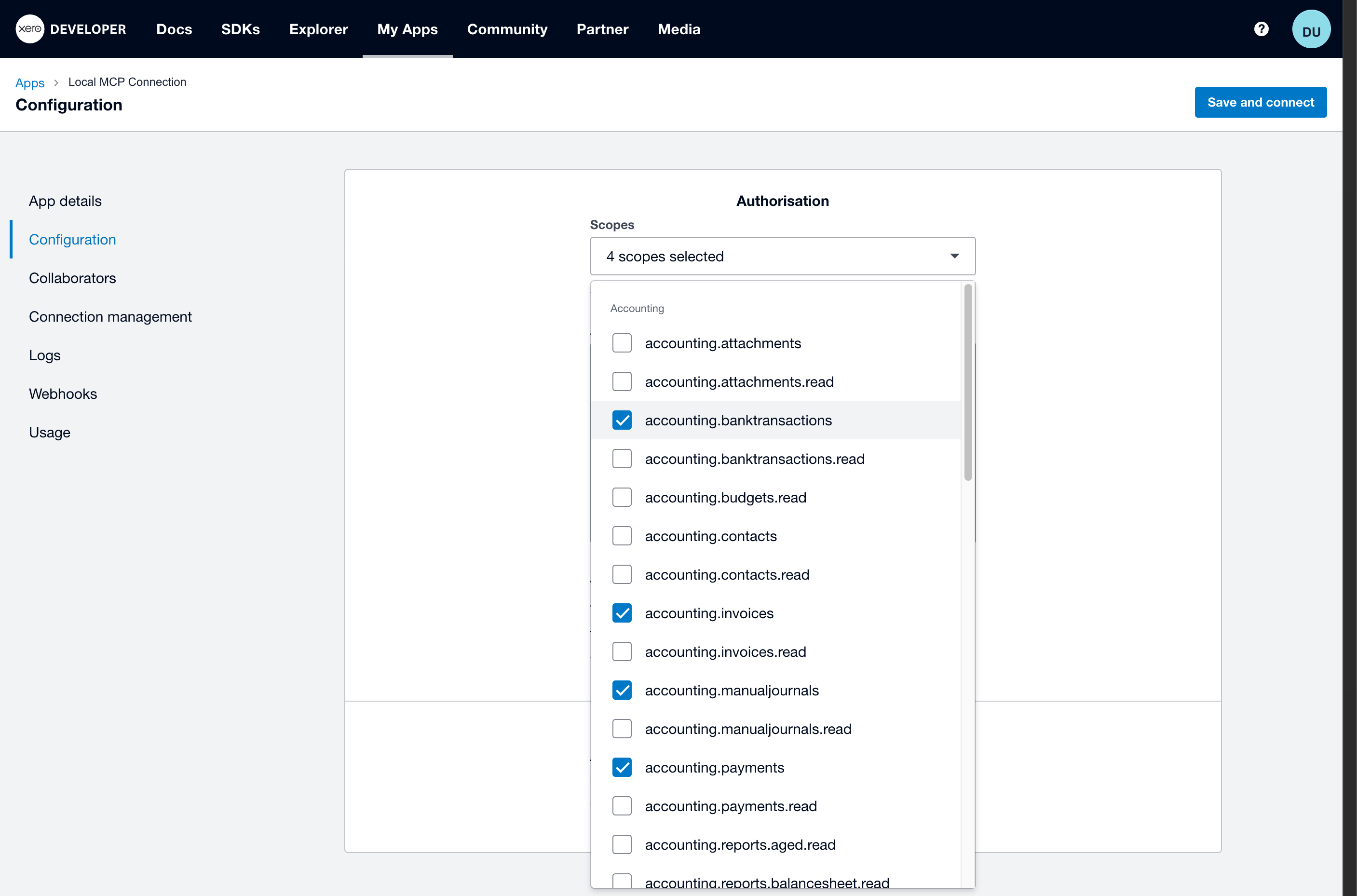 Use the scope selector deliberately. Do not copy broad or write-capable screenshots into production.
Read Scopes Versus Write Scopes
In Xero’s Accounting API, read scopes are usually explicit:
accounting.invoices.read
accounting.payments.read
accounting.banktransactions.read
accounting.manualjournals.read
The matching scopes without .read are broader and can support write-capable operations:
accounting.invoices
accounting.payments
accounting.banktransactions
accounting.manualjournals
For most self-serve finance Q&A, choose read scopes. Write-capable scopes belong in controlled workflows with a trusted operator, not in a broad “ask anything about Xero” rollout.
Common Scope Groups for Xero MCP
Use this as a planning map, not a copy-paste list.
| Goal | Starting scopes |
|---|---|
| Test organisation details | accounting.settings.read |
| Read invoice lists and balances | accounting.settings.read accounting.invoices.read |
| Read contacts | The current contact scope required by Xero, listed in the official MCP server docs as accounting.contacts |
| Read payments | accounting.settings.read accounting.payments.read |
| Read bank transactions | accounting.settings.read accounting.banktransactions.read |
| Read reports | Add the exact report scope required by the official server, such as accounting.reports.aged.read, accounting.reports.balancesheet.read, accounting.reports.profitandloss.read, or accounting.reports.trialbalance.read |
| Payroll tests | Add payroll scopes only for the supported country and approved user group |
The exact scope names available to your app can vary with Xero’s granular-scope rollout and the type of connection. Always confirm in Xero Developer before publishing setup instructions internally.
Granular Scopes After April 2026
Xero introduced granular Accounting API scopes in 2026. For Custom Connections created from 29 April 2026, new granular scopes apply. Xero’s FAQ also notes that older broad scopes can continue during the transition if they remain in an existing configuration, but removed broad scopes cannot be re-added.
That means two Xero MCP setups can behave differently:
- An older Custom Connection may still have broad scopes.
- A newer Custom Connection uses granular scopes.
- Changing an activated Custom Connection can require re-authorisation.
When troubleshooting a scope problem, always check when the Custom Connection was created and whether it was edited after activation.
The Official Xero MCP Server Scope Behavior
The official Xero MCP server supports two auth modes:
- Custom Connections with Client ID and Client Secret
- Bearer token mode for clients that handle OAuth at runtime
The server documentation says Custom Connections require different scope sets depending on when the connection was created. It also allows overriding scopes with the XERO_SCOPES environment variable.
Example:
XERO_SCOPES=accounting.settings.read accounting.invoices.readKeep XERO_SCOPES aligned with the scopes actually authorised in Xero Developer. If they do not match, expect invalid_scope or missing tools.
Scopes to Avoid in a First Test
Scopes are only one of the things that can go wrong here. The other risks of connecting AI to your books are worth reading first.
Do not use these for the first connectivity check:
- Invoice write scopes
- Payment write scopes
- Bank transaction write scopes
- Manual journal write scopes
- Payroll scopes
- Deprecated broad scopes unless you are maintaining an existing connection
First prove the server can read organisation details. Then add exactly one data area at a time.
A Practical Scope Review Checklist
Before using Xero MCP against real data, answer these:
- Which tools will users actually need?
- Which scopes does each tool require?
- Does any scope allow create, update, approve, or delete behaviour?
- Is this a Custom Connection or a multi-tenant OAuth app?
- Who can edit the scope list later?
- Will changes force re-authorisation?
- Where is the final approved scope list documented?
FAQ
What scope should I use first for Xero MCP?
Use accounting.settings.read for the first Demo Company test. It lets the server read basic organisation details without granting invoice, payment, bank transaction, or write access.
Are Xero MCP scopes read-only by default?
No. Xero scopes are explicit permissions. Read scopes usually end in .read. Scopes without .read often allow create or update behaviour for that area.
What changed for Xero Custom Connection scopes in 2026?
Xero introduced granular Accounting API scopes in 2026. New Custom Connections from 29 April 2026 use granular scopes, while older broad scopes continue for existing configurations during Xero’s transition window.
Next, see Xero MCP Custom Connections vs OAuth Apps or the full Xero MCP guide.